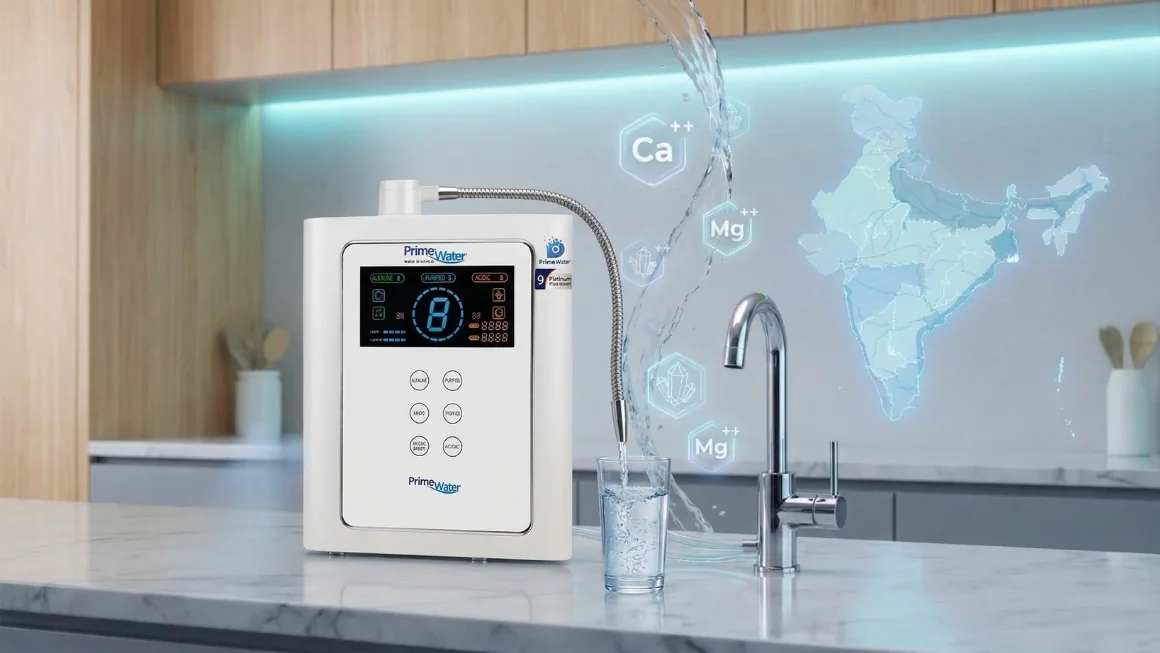
One of the most important — and most overlooked — factors in choosing an alkaline water ionizer in India is your local water quality. The same machine produces very different results in Delhi versus Chennai, or in a borewell-fed home versus a municipal-supply apartment.
Understanding your water's TDS (Total Dissolved Solids), hardness, and pH will help you choose the right ionizer model, understand what output to expect, and maintain your machine properly.
This guide covers everything you need to know — backed by city-level water quality data and mapped directly to the right Prime Water model for your situation.
Quick Navigation
Understanding TDS — Total Dissolved Solids
TDS measures the total concentration of dissolved minerals, salts, and metals in your water, expressed in parts per million (ppm) or mg/L. The higher the TDS, the more dissolved material is in your water — and the more it matters which ionizer model you choose.
For water ionizers, TDS is critical because the ionisation process relies on dissolved minerals to conduct electrical current through water. Too little TDS and the electrolysis is weak. Too high and the machine has to work harder, requiring more electrode plates to achieve the same output quality.
| TDS Level | Water Quality | Common Sources in India | Ionizer Recommendation |
|---|---|---|---|
| 0–50 ppm | Ultra-pure (too low) | RO output without remineralisation | Add minerals before ionising — or use 7-plate with remineralisation filter |
| 50–150 ppm | Soft, low mineral | RO water with some minerals, some metro municipal supply | 7-plate model works well |
| 150–300 ppm | Moderately soft | Good municipal supply (Bangalore, Hyderabad, Mumbai) | 7 or 9-plate — ideal range ✓ |
| 300–500 ppm | Moderate hardness | Delhi, Noida, Gurgaon municipal supply, many North Indian cities | 9 or 11-plate recommended |
| 500–700 ppm | Hard water | Haryana, Punjab, parts of Rajasthan borewell, UP | 11-plate minimum, 13 preferred |
| 700–1200 ppm | Very hard water | Many North India borewell sources, arid regions | 13-plate, may need pre-softener |
| Above 1200 ppm | Extremely hard | Industrial areas, fluoride-heavy groundwater zones | Pre-treatment required before ionising |
Related reading: 7 Plate vs 9 vs 11 vs 13 Plate — Which Should You Buy? · View All Prime Water Models
How to Check Your Water TDS
You don't need to send your water to a lab to get a usable TDS reading. Here are four practical ways to find out your water quality before buying an ionizer.
Buy a Pen-Style TDS Meter (₹200–400)
Available on Amazon or any hardware store. Dip into your tap water — you get a reading in 10 seconds. This is the fastest and most reliable method. Any reputable ionizer seller should also bring a TDS meter for your in-home demo and let you measure yourself.
Ask Your RO Technician
Anyone who maintains your existing water purifier will know your water TDS from their last filter change. They monitor this to know when filters need replacing — your number is already in their records.
Check Your Municipal Water Quality Report
Most Indian metros publish annual water quality data. Delhi Jal Board, BWSSB (Bangalore), BMC (Mumbai), CMWSSB (Chennai), and HMWS&SB (Hyderabad) all publish this publicly. Search "[your city] water quality report 2026" to find the latest data for your area.
Ask Your Neighbours
People in your building or locality share the same water source — someone has likely had their water tested already. Building committee members, society secretaries, or anyone with an RO system will often have this information.
Water Hardness — Different from TDS
Water hardness specifically measures calcium and magnesium ion concentration. Hard water is not dangerous to drink, but it causes limescale buildup in appliances (including water ionizers), reduces lather from soap, and directly affects the ionizer's electrolysis efficiency.
Hardness is measured in mg/L of CaCO₃ or in German degrees (°dH). For ionizer owners, the practical implication is maintenance frequency and plate longevity.
Ideal for ionizers — minimal maintenance required, maximum plate efficiency, longest filter life. Mumbai, Pune, most South Indian cities fall here.
Normal maintenance schedule applies. The machine's built-in auto-cleaning cycles handle this range well without any additional steps. Most metro municipal supplies.
Requires more frequent plate cleaning cycles. Most Prime Water models have auto-cleaning after each use, but running the acidic water mode for 3–5 minutes weekly is recommended. Delhi, Hyderabad municipal supply often falls here.
May require a water softener or descaling pre-treatment before ionising. Annual professional servicing strongly recommended. Common in Haryana and Rajasthan borewell sources. Contact Prime Water to assess your specific situation.
Practical tip: If your taps or bathroom tiles have white mineral deposits (limescale) or your soap doesn't lather well, you're almost certainly dealing with hard water above 200 mg/L. This is a direct indicator that you should choose at minimum a 9 or 11-plate model and plan for regular maintenance.
Water pH by Indian City — What to Expect
Indian water quality varies dramatically not just by city, but by season, source (river vs. borewell), and even by neighbourhood. The table below is a practical guide based on typical ranges — always test your actual tap water before finalising your ionizer choice.
| City / Region | Typical Source | Typical pH | Typical TDS | Ionizer Notes |
|---|---|---|---|---|
| Delhi / NCR | Yamuna river, groundwater mix | 7.0–7.8 | 300–600 ppm | Moderate-hard. 9–11 plate recommended. |
| Mumbai | Vihar / Tulsi lakes | 7.2–7.6 | 100–200 ppm | Soft municipal water. 7–9 plate ideal. |
| Bangalore | Cauvery river, borewell | 7.0–7.5 | 150–400 ppm | Variable by area. 9-plate safe choice. |
| Hyderabad | Krishna / Godavari | 7.2–7.8 | 200–450 ppm | Moderately hard. 9-plate recommended. |
| Chennai | Groundwater, reservoirs | 7.5–8.0 | 300–600 ppm | Harder in summer. 9–11 plate. |
| Haryana / Punjab (borewell) |
Groundwater | 7.5–8.5 | 500–1000+ ppm | Very hard — fluoride risk. 11–13 plate. |
| Rajasthan (borewell) |
Groundwater | 7.8–8.8 | 600–1200+ ppm | Extremely hard. 13-plate + pre-treatment. |
| Kolkata | Hooghly river | 6.5–7.5 | 100–300 ppm | Moderate. 7–9 plate works well. |
| Pune | Khadakwasla reservoir | 7.0–7.5 | 150–300 ppm | Soft-moderate. 7–9 plate ideal. |
Related reading: 7 vs 9 vs 11 vs 13 Plate — Complete Comparison Guide · Prime Water Certifications
The Special Problem of RO + Ionizer
Many Indian households already have an RO (reverse osmosis) purifier. A common question: can you connect a water ionizer after your RO, or do you need to choose one or the other?
The answer requires nuance. RO removes almost all dissolved minerals, producing water with very low TDS (often 10–30 ppm). Water ionizers need dissolved minerals to conduct the electrical current for electrolysis — with near-zero TDS water, an ionizer produces very weak ionisation and the ORP barely changes.
Best Option: Connect Ionizer to Municipal Tap Supply (Pre-RO)
Connect the ionizer directly to your municipal tap, not to the RO output. The ionizer's own dual filtration system handles purification — activated carbon removes chlorine, organic compounds, and heavy metals. This is what Prime Water machines are designed for and produce the best ionisation results.
If You Must Use RO Water: Add a Remineralisation Filter
Add a remineralisation filter after your RO and before the ionizer. This adds back calcium and magnesium, raising TDS to a usable 50–100 ppm range. This approach works but adds cost and a maintenance step. Prime Water can advise on compatible setups.
Not Recommended: RO Water Directly Through an Ionizer
Running very low TDS RO water (10–30 ppm) directly through an ionizer strains the machine, produces poor-quality output (weak ORP, unstable pH), and significantly shortens plate lifespan. Many sellers don't mention this — now you know.
Related reading: Is Alkaline Water Good for You? Science-Based Guide for Indian Families · Why Alkaline Water?
Fluoride in Indian Water — What Ionizers Do
High fluoride in groundwater is a documented public health concern across 19 Indian states — including Haryana, Rajasthan, UP, Andhra Pradesh, and Telangana. At elevated concentrations, fluoride causes dental fluorosis (mottling) and skeletal damage.
⚠️ What ionizers can and cannot do about fluoride
Prime Water machines use a dual-stage filter: activated carbon plus bio-ceramic ball. Activated carbon does reduce fluoride to some extent, but dedicated fluoride removal requires a specific activated alumina or bone char pre-filter stage.
If you're in a high-fluoride area (Haryana, Rajasthan, parts of Punjab and UP), ask about adding a fluoride pre-filter stage before the ionizer. Prime Water's service team can advise based on your specific water quality report.
Indian states with documented high-fluoride groundwater zones:
Maintaining Your Ionizer — Indian Water Considerations
Indian water conditions — particularly the wide variation in hardness and TDS — mean that maintenance requirements here differ from the standard guidance written for softer water markets like Japan or Europe. Here's what to adjust based on your water.
Auto-Cleaning Cycles
All Prime Water models run an automatic cleaning cycle before and after each use. In hard water areas (above 200 mg/L hardness), additionally run the acidic water mode for 3–5 minutes weekly to actively descale the electrode plates. This takes 2 minutes and significantly extends plate life.
Filter Replacement — Adjust for High TDS
The standard 18-month filter life is calibrated for moderate water quality. In high-TDS areas (500+ ppm), check filters at 12 months rather than waiting for the 18-month mark. A clogged filter reduces ionisation output and strains the SMPS. Filter replacement runs ₹5,000–8,000 and takes 10 minutes.
Watch for pH Drop — the Scaling Signal
If your machine's water output pH drops over time (e.g., from consistent pH 9 to pH 8 or lower at the same setting), this usually indicates scale buildup on the electrode plates reducing their effective surface area. Contact Prime Water's service team — professional descaling restores full performance.
Annual Service Check-Up
An annual check-up is recommended for all ionizers operating in Indian water conditions — checking plate health, filter condition, SMPS output, and connection integrity. Prime Water's service team visits across India. Schedule your annual service →
Which Prime Water Model Is Right for Your Water?
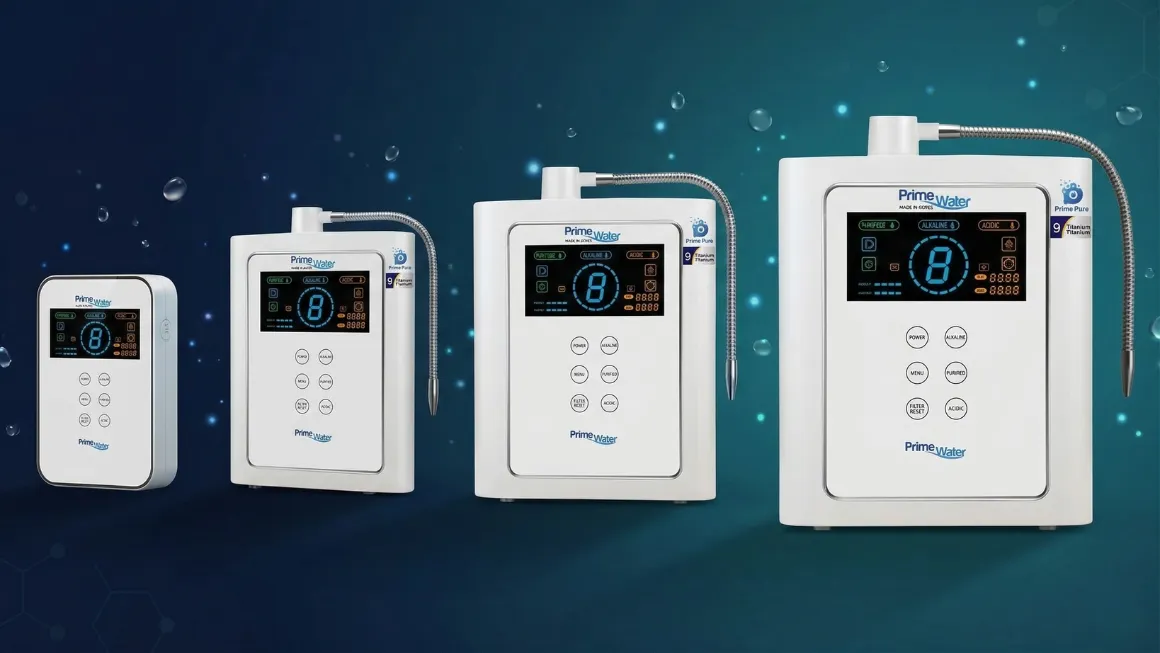
Use this quick reference to match your water quality to the right model. When in doubt between two options, always choose the higher plate count — you won't regret the extra capability, but you will regret an under-powered machine in hard water.
Mumbai, Pune, Kolkata, most South Indian cities on municipal supply. Soft water households.
View RWB-7 Plate →Bangalore, Hyderabad, Delhi municipal supply, Chennai. Best value for most Indian urban households.
View RWW-9 Plate →Delhi NCR (harder areas), Haryana, Punjab municipal, parts of UP and MP. Hard water households.
View RWS-11 Plate →Rajasthan borewell, Haryana borewell, arid region groundwater. Very hard and extremely hard water.
View RBB-13 Plate →Not Sure Which Model Fits Your Water?
Book a Free In-Home Water Test + Demo
Our team will test your TDS, pH, and hardness on-site and recommend the right model for your water — at no cost.