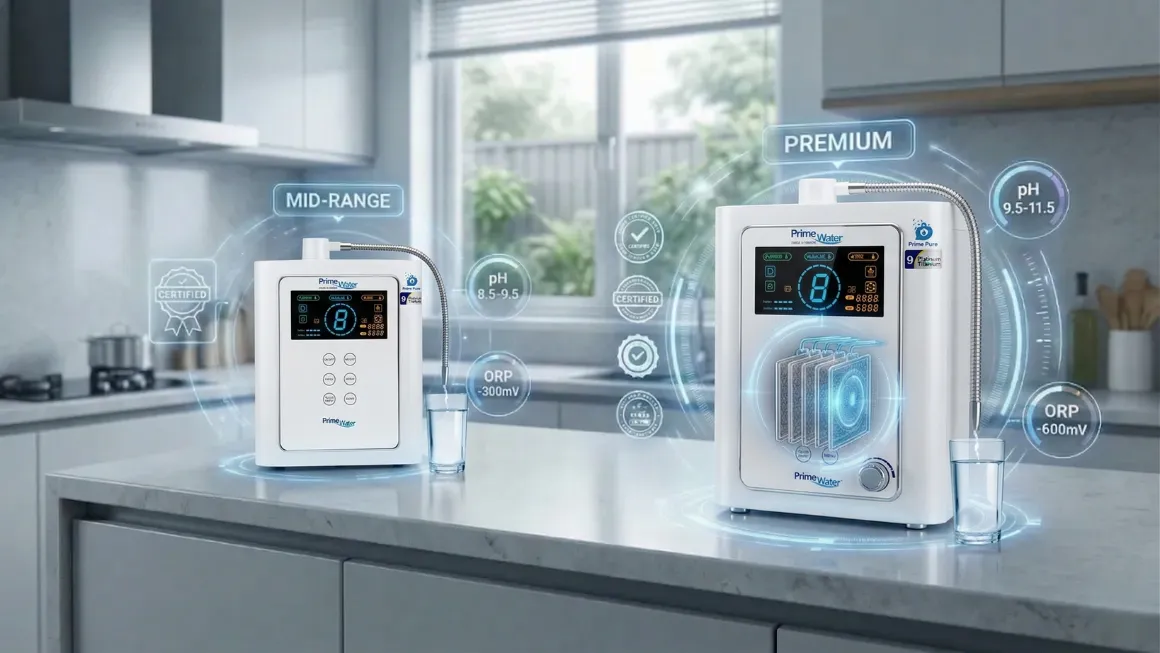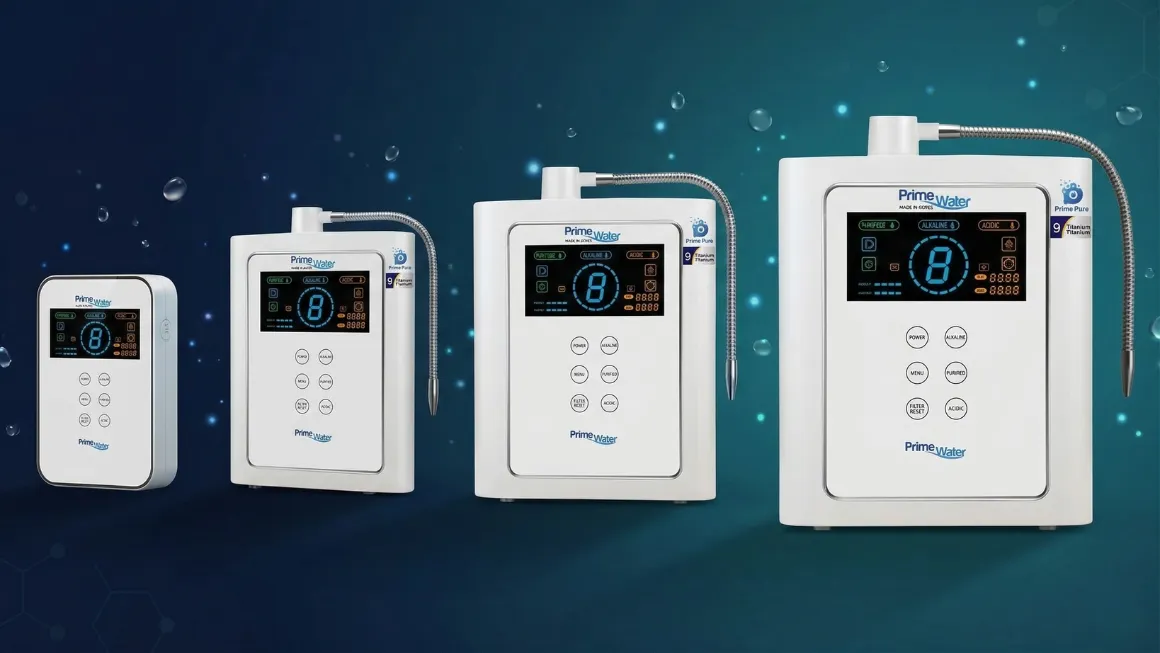
When you're shopping for an alkaline water ionizer in India, one number appears everywhere: the plate count. 7 plates. 9 plates. 11 plates. 13 plates. It affects price significantly — from ₹1,82,998 for a 7-plate countertop to ₹3,17,998 for a 13-plate faucet model.
So what do plates actually do? And how many do you need? This guide answers both, without the marketing fluff.
What Are Electrode Plates?
Inside every ionizer is an electrolysis chamber with platinum-coated titanium plates. An electrical current splits water into alkaline (ionised) water on one side and acidic water on the other. The plates are the engine of ionisation.
More plates means:
- →Larger surface area for electrolysis
- →More powerful ionisation at lower current (better longevity)
- →Stronger negative ORP — the antioxidant measure
- →Better performance with hard or high-TDS water
- →Higher alkaline water output per minute
Understanding ORP
ORP (Oxidation Reduction Potential) is measured in millivolts (mv). A negative ORP means antioxidant water — electrons that neutralise free radicals. The more negative, the stronger the antioxidant effect.
Tap water in India: +100 to +400 mv. A 7-plate ionizer: –700 to –900 mv. A 13-plate faucet model: up to –1,250 mv. That's a significant difference — which is the main health reason people buy an ionizer.
All Models at a Glance
Countertop R Series
Under-Sink Faucet Series
Find Your Model in 3 Steps
How many people in your household?
- →1–3 people → 7-plate
- →3–4 people → 9-plate
- →4–6 people → 11-plate
- →6+ people or office/clinic → 13-plate
What is your water TDS?
Check your RO technician's report or buy a ₹300 TDS meter
Counter or under-sink?
- →Renting or want flexibility → Countertop R Series
- →Own your home, want max ORP and clean kitchen look → Faucet Series
How Many Plates Do You Need?
7-Plate — Entry Point
- →1–3 people, TDS under 300 ppm
- →Municipal water in metros
- →Most affordable starting point
9-Plate — Best Value
- →3–4 people, TDS 300–500 ppm
- →Common in Delhi, Haryana, Rajasthan
- →Our most popular countertop model
11-Plate — North India Standard
- →4–6 people, TDS 500–700 ppm
- →Borewell areas of North India
- →Small offices, clinics, yoga studios
13-Plate — Maximum Performance
- →6+ people or commercial use, TDS above 700 ppm
- →Maximum ORP up to –1,250 mv
- →More plates, better ORP, lower price than Kangen SD501 (7-plate)
Countertop vs Under-Sink
Countertop (R Series): Sits beside your tap. Easy to install, portable, no plumber needed. Best for renters or DIY installs.
Under-Sink Faucet Series: Hidden below counter with a dedicated tap. Cleaner kitchen look, saves counter space, slightly higher ORP. Best for homeowners wanting a permanent setup.
The TDS Factor in India
Municipal supply in metros runs 100–300 ppm. Borewell water in Haryana, Rajasthan, UP often hits 500–900 ppm. Hard water demands more plates for the same ionisation quality. A 7-plate machine on 700 ppm water won't deliver the same ORP as a 13-plate handling the same source comfortably.
To check your TDS: ask your RO technician or buy a ₹300 TDS meter from any hardware store.
Prime Water's Recommendation
For a North Indian family of 4, we recommend the 11-plate model. Four adults drinking 2–3 litres daily on North Indian borewell water (typically 400–600 ppm TDS) is exactly what the 11-plate is built for — comfortable, consistent performance with room to grow.
The 9-plate is ideal if your family is 3 people or your TDS is confirmed below 400 ppm. It's our most popular countertop model for good reason.
All models: 2-year full guarantee · 10-year plate chamber warranty · 18-month filter life · Free installation across India.
FAQ
Is 7-plate enough for a family of 4?
Only if your TDS is below 300 ppm. For most North Indian homes above 400 ppm TDS, the 7-plate will struggle to produce consistent ORP at the daily volume a family of 4 needs. The 9 or 11-plate is the safer choice.
Is the water visually different between 7 and 13 plates?
No — it looks identical. The difference shows up on an ORP meter and in how the machine performs under load. Higher plate machines run cooler, last longer, and maintain consistent output on hard water.
Best model for Delhi water?
Delhi municipal TDS runs 200–400 ppm. The 9-plate countertop handles this comfortably for a standard family of 3–5.
Best model for North India borewell water?
Borewell water in UP and Rajasthan commonly runs 500–900 ppm TDS. We strongly recommend the 11 or 13-plate. At this level, a 7 or 9-plate works near its limit and ORP output becomes inconsistent.
Does more plates mean higher electricity bills?
Not significantly. The wattage difference between plate counts is modest. The bigger factor is countertop vs faucet series — faucet uses more wattage, but the per-litre cost is still minimal.
Prime Water 13-plate vs Kangen SD501?
Kangen SD501 is a 7-plate machine at ₹2.85–4.5 lakhs through MLM distributors. Prime Water's 13-plate countertop is ₹2,72,998 — more plates, higher ORP, 10 international certifications including KFDA, and zero distributor commission in the price.
Not Sure Which Model Is Right for You?
Request a free in-home demo — we'll test your water TDS and recommend the right model.
📞 +91-9812311156 | 📧 info@theprimewater.com
Free demo across India · Korean KFDA certified · 10-year plate warranty