- By Prime Water
- 07 Mar, 2026
Category:
Alkaline Water
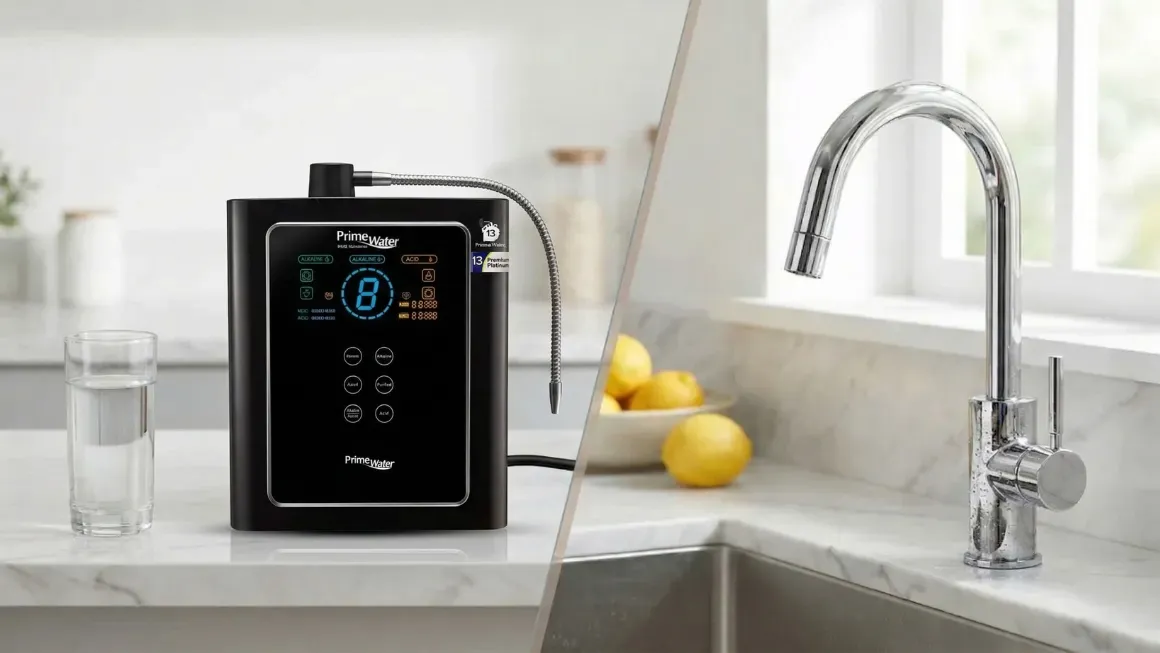
When you've decided to invest in an alkaline water ionizer machine, one important decision remains: countertop or under-sink installation? Both deliver the same ionised alkaline water. But the installation type affects your kitchen layout, counter space, water flow, and the overall user experience significantly.
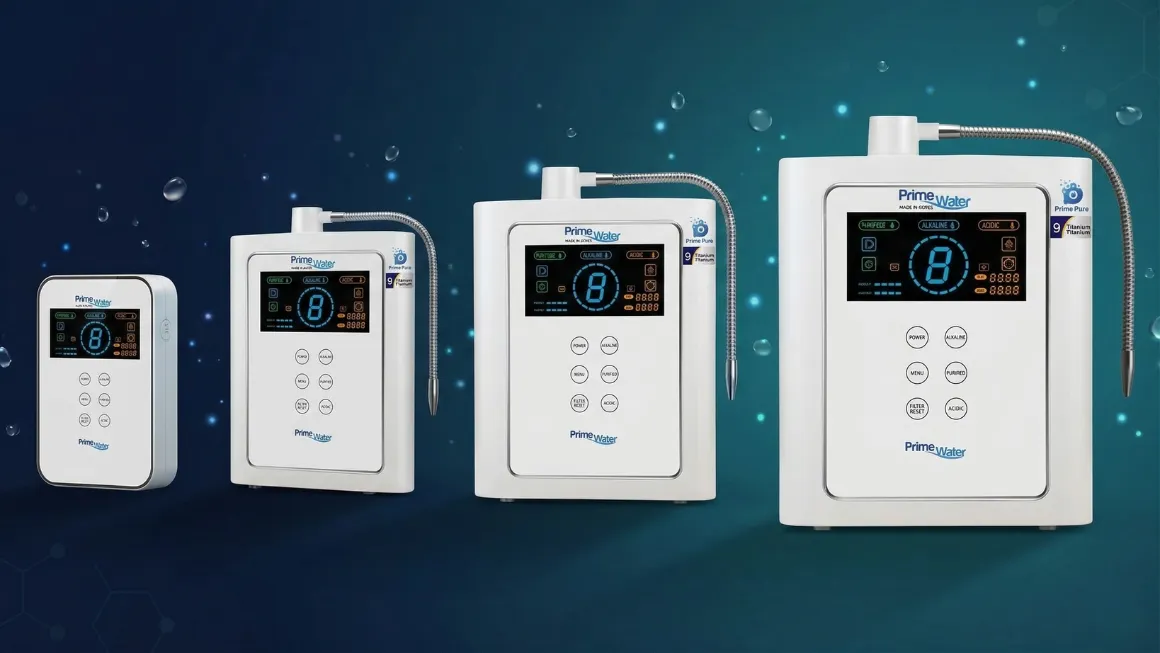
This guide covers the real differences between Prime Water's R Series (countertop) and Faucet Series (under-sink) — so you can choose the right setup for your home before you buy.
Countertop Ionizer — R Series
A countertop alkaline water ionizer sits on your kitchen counter and connects directly to your existing tap via a diverter valve. You turn on the tap, and water flows through the ionizer, producing alkaline water from its dedicated spout. Turning the tap the other way bypasses the ionizer for normal tap usage — no changes to your existing plumbing at all.
Prime Water's R Series — RWB-7, RWW-9, RWS-11, RBB-13 — are countertop models ranging from ₹1,82,998 to ₹2,72,998.
- Easy DIY installation — connect to existing tap in 30 minutes, no plumber needed
- Portable — move to a new room, take to a new home, disconnect anytime
- Visible display — controls and pH panel at counter level, easy to use
- Lower price — ₹30,000–45,000 less than equivalent faucet models
- Renter-friendly — no plumbing modification needed, no landlord permission required
⚠ Countertop Disadvantages
- Takes counter space — typically 25–35 cm wide; significant in smaller Indian kitchens
- Visible pipes — the diverter valve and flexible hose from tap to machine are visible
- Separate spout — alkaline water comes from the machine's spout, not your main tap
- Lower max ORP — up to –900 mv vs –1,250 mv on the 13-plate faucet model
Under-Sink Faucet Ionizer — Faucet Series
The under-sink faucet installation places the ionizer unit inside your kitchen cabinet under the counter, connected to your cold water supply pipe. A new dedicated tap — supplied with the machine — is installed through a hole in your counter or sink. You get alkaline water from this dedicated tap; your existing kitchen tap remains completely unchanged.
Prime Water's Faucet Series — RWB Faucet, RWW Faucet, RWS Faucet, RBB Faucet — are under-sink models ranging from ₹2,27,998 to ₹3,17,998.
- Zero counter space — machine hidden inside cabinet, counter stays completely clear
- Cleaner aesthetic — only the elegant faucet tap is visible, looks integrated
- Higher ORP output — up to –1,250 mv on the 13-plate due to higher wattage
- Higher flow rate — 3 L/min standard; better for larger families
- Premium feel — built-in kitchen appliance rather than an add-on
- Quieter operation — machine noise is muffled inside the cabinet
⚠ Under-Sink Disadvantages
- Plumber required — counter/sink drilling + cold water pipe connection (₹500–1,500 typically)
- Not portable — once installed, moving it requires undoing plumbing
- Higher price — ₹30,000–45,000 more than equivalent countertop model
- Controls under counter — display is inside the cabinet; operated via tap handle or separate controller
Side-by-Side Comparison
Both installation types use the same KFDA-certified Korean electrolysis technology. The differences are practical — space, budget, installation complexity, and long-term intent.
| Factor |
Countertop — R Series |
Under-Sink — Faucet Series |
| Price range |
₹1,82,998 – ₹2,72,998 |
₹2,27,998 – ₹3,17,998 |
| Counter space needed |
Yes — 25–35 cm width |
None — machine under sink ✓ |
| Installation difficulty |
Easy DIY — 30 min ✓ |
Requires plumber — 1–2 hrs |
| Installation cost |
₹0 (DIY) |
₹500–1,500 (plumber) |
| Portability |
Yes — easily moved ✓ |
No — plumbing connection |
| ORP output (max) |
–700 to –900 mv |
Up to –1,250 mv (13-plate) ✓ |
| Flow rate |
2–3 L/min |
3 L/min ✓ |
| pH range |
2.5 to 11.5 |
2.5 to 11.5 |
| Suitable for renters |
Yes ✓ |
Best for homeowners |
| Kitchen aesthetic |
Machine visible on counter |
Only elegant faucet visible ✓ |
| Noise during use |
Audible on counter |
Muffled inside cabinet ✓ |
| Best for family size |
Up to 5–6 (11-plate) |
All sizes — 7 to 13 plate ✓ |
| Best for |
First ionizer, rental, budget-conscious |
New kitchen, premium setup, large family |
Both types use identical KFDA-certified Korean electrolysis technology. Performance differences are marginal — the choice is primarily about your kitchen, budget, and lifestyle.
Which Indian Kitchens Suit Each Type?
Indian kitchen layouts vary dramatically — from 40 sq ft Mumbai galley kitchens to large open-plan spaces in independent houses. Here's how to match the installation type to your actual kitchen.
- You're renting and can't modify kitchen plumbing
- Your counter has good space and you don't mind the machine being visible
- You want the flexibility to take it when you move homes
- Budget is a consideration — save ₹30,000–45,000 vs the faucet model
- You're trying alkaline water for the first time and want easier reversibility
- Your water is soft to moderate TDS (Mumbai, Pune, Bangalore municipal)
- You own your home and want a permanent installation
- Counter space is limited — very common in Indian 1–2 BHK apartments
- You're doing a kitchen renovation — ideal time to install under-sink
- You want a cleaner, more premium kitchen aesthetic (modular kitchen setup)
- You want maximum ORP output — up to –1,250 mv on the 13-plate
- Family size is 4+ and you want higher consistent flow rate
- You're investing for the long term — 15–20 year appliance lifespan
Indian apartment kitchens specifically: The average 2 BHK kitchen in cities like Mumbai, Delhi, Bengaluru, or Hyderabad has 6–10 sq ft of counter space. In these kitchens, a countertop ionizer (25–35 cm wide) claims a meaningful portion of that space. If you have a modular kitchen with an under-counter cabinet, the faucet series is typically the smarter long-term choice — both aesthetically and functionally.
Installation Guide — What to Expect
Countertop Installation — DIY in 30–45 Minutes
1
Attach the diverter valve to your existing kitchen tap. Fits most standard Indian taps — no tools needed. The diverter has a lever that switches between normal tap flow and ionizer flow.
2
Connect the flexible inlet hose from the diverter valve to the ionizer's water inlet port. Finger-tight — no tools required.
3
Place the ionizer on your counter in a stable, flat position near the tap. Ensure the power socket is within reach.
4
Connect the waste water outlet hose — leads from the machine's acidic water outlet into your sink. Can be clipped to the sink edge or directed into the drain.
5
Power on and flush for 5 minutes in alkaline mode into the sink to prime the new filter. Then verify pH and ORP output match expected values before drinking.
Under-Sink Faucet Installation — Plumber Required (1–2 Hours)
1
Plumber connects the ionizer unit to the cold water supply pipe under the sink using the included fittings. The machine sits inside the cabinet on the cabinet base.
2
Plumber drills a 32mm hole in your counter or sink deck for the dedicated alkaline water faucet tap. In granite counters, a diamond drill bit is used — plan this carefully.
3
Faucet tap installed through the drilled hole and secured from underneath with the supplied nut and washer. The tap supply line connects to the ionizer's outlet port.
4
Waste water hose connects from the machine's acidic outlet to the under-sink drain pipe. The acidic water is discharged automatically during ionisation.
5
Power supply connected — Prime Water supplies a 450W SMPS adaptor. The power cable runs from the machine inside the cabinet to a socket inside the cabinet or nearby.
6
System flushed and tested — run 5 litres through before first use, verify pH and ORP output. Prime Water provides full installation support by phone during this step.
Planner's tip: If you're installing the faucet model during a kitchen renovation, plan the dedicated tap location before counter/slab work is complete. Adding the hole during construction is easier and cleaner than drilling into a finished granite or marble counter later. Discuss placement with your interior designer or contractor in advance.
Model Picker — Countertop vs Faucet by Plate Count
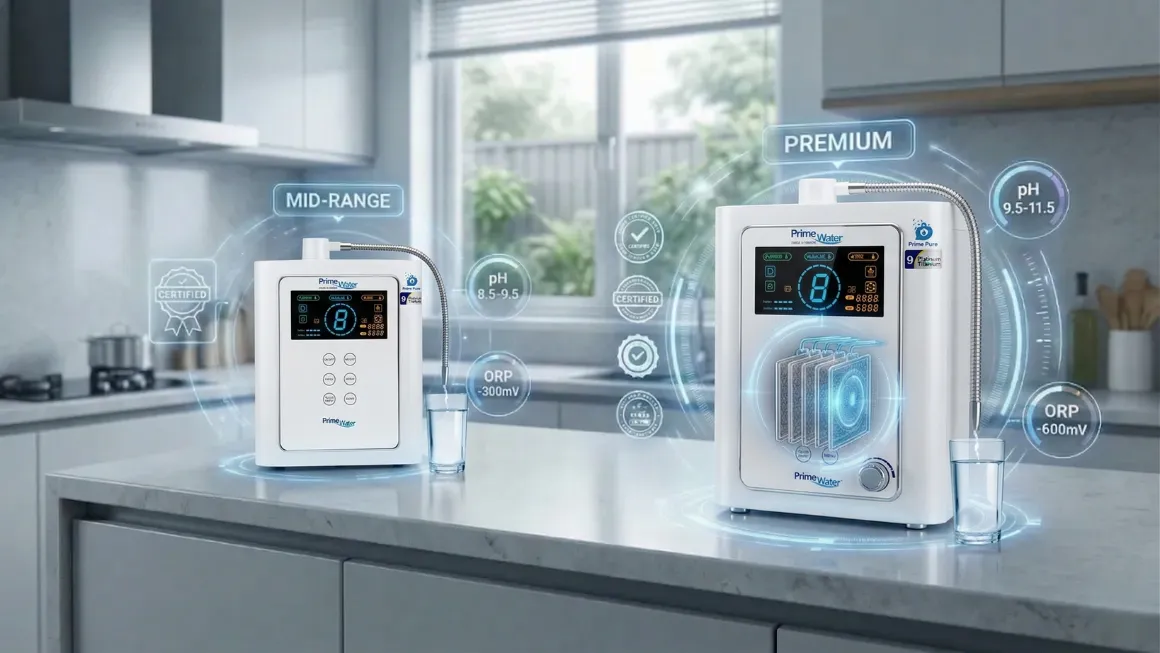
Both the R Series (countertop) and Faucet Series (under-sink) are available in 7, 9, 11, and 13 plates. Match your plate count to your water's TDS level — see our TDS and hardness guide for city-by-city recommendations.
| Plates |
TDS Range |
Countertop (R Series) |
Under-Sink (Faucet) |
| 7 Plates |
50–300 ppm |
RWB-7 Plate — ₹1,82,998 |
RWB Faucet 7 — ₹2,27,998 |
| 9 Plates ⭐ |
150–500 ppm |
RWW-9 Plate — ₹2,22,998 |
RWW Faucet 9 — ₹2,67,998 |
| 11 Plates |
400–700 ppm |
RWS-11 Plate — ₹2,62,998 |
RWS Faucet 11 — ₹3,07,998 |
| 13 Plates |
600–1200+ ppm |
RBB-13 Plate — ₹2,72,998 |
RBB Faucet 13 — ₹3,17,998 |
Frequently Asked Questions
Q1. Does the water quality differ between countertop and under-sink models?
Both use the same KFDA-certified electrolysis technology and produce the same ionised alkaline water. The practical difference is that the faucet (under-sink) series uses a slightly higher wattage power supply, which gives it marginally higher maximum ORP output — up to –1,250 mv vs –900 mv on the countertop series. For most households, this difference is not meaningful. The pH range (2.5–11.5) is identical across both series.
Q2. I'm in a rented apartment. Can I install an under-sink model?
Technically possible but practically complicated. Under-sink installation requires drilling a hole in the counter or sink — which is a permanent modification. Most landlords in India would not permit this without explicit consent, and restoring the counter when you vacate is difficult. For rented homes, the countertop R Series is the strongly recommended choice. It installs and uninstalls in 30 minutes, leaves no marks, and travels with you when you move. If you plan to buy a home in the near future, wait and do the faucet installation there.
Q3. How much counter space does a countertop ionizer actually take?
Prime Water's countertop R Series models measure approximately 30 cm wide × 15 cm deep × 35 cm tall. In a standard Indian 2 BHK kitchen with roughly 6–8 sq ft of counter space, this occupies about 15–20% of usable counter area. In a compact galley kitchen or a studio apartment kitchen, this is a significant portion. In a larger modular kitchen, it's more manageable. Measure your available counter space before deciding — the faucet series may offer better long-term comfort even if the countertop is technically possible.
Q4. What kind of plumber do I need for under-sink installation?
Any experienced local plumber can do the installation — it's a standard under-counter cold water tap connection, similar to installing a water purifier. The only specific requirement is drilling the counter hole if your sink/counter doesn't already have a spare hole (some sinks come with one pre-drilled). For granite counters, the plumber may need a diamond drill bit. Prime Water's team can talk your plumber through the process over a call if needed. Factor in ₹500–1,500 for plumber cost in most Indian cities. Contact Prime Water for installation guidance →
Q5. Can I convert a countertop model to under-sink later?
The countertop R Series and under-sink Faucet Series are separate product lines — you cannot physically convert one into the other. However, if you start with a countertop model in a rented home and later want an under-sink setup when you buy your own home, you can purchase a Faucet Series unit for the new home and keep the countertop unit for a second location (e.g. parent's home, office). Both models use the same filter cartridges, making it easy to manage two units. View all Prime Water models →
Q6. My existing kitchen tap doesn't look compatible with a diverter valve. What do I do?
Prime Water's diverter valve fits most standard Indian kitchen taps — including common ISI-marked single-body taps, pillar cocks, and bib taps. If your tap has an unusual thread size or non-standard outlet, Prime Water supplies adaptor fittings. For very unusual tap configurations (rare American or European threads), a short adapter from any plumbing hardware store (₹50–150) resolves the issue. The Prime Water team can advise you on compatibility before purchase — contact them with your tap type →
Q7. Is maintenance different between countertop and under-sink models?
The core maintenance tasks are identical — filter replacement (every 12–18 months depending on water TDS), plate descaling, and annual service checks. The practical difference is access: the countertop model's filter is easily accessible on the counter, while the under-sink model's filter requires opening the cabinet. For manual descaling (running acidic water mode), the countertop user does this at the counter; the faucet user does it at the dedicated tap. Our full maintenance guide for Indian conditions covers both models in detail.
Q8. We're building a new home. When is the best time to plan the ionizer installation?
At the plumbing rough-in stage — before the kitchen counter is laid. At this point, a plumber can route a dedicated cold water supply line to your intended ionizer location and leave a stub-out inside the cabinet. When the counter is being fabricated, ask the fabricator to leave a 32mm pre-drilled hole at the faucet tap location. Doing both of these things during construction costs very little (₹500–1,000) and makes the final installation completely clean. Installing after construction — especially drilling into a finished granite or marble counter — is messier and more expensive. Talk to Prime Water's team during your planning stage →
Q9. Which plate count should I choose for my city's water?
The plate count should match your water's TDS level. As a general guide: Mumbai, Pune, Bangalore, and most South Indian cities on municipal supply (80–250 ppm) do well with a 7-plate model. Delhi, Noida, Gurgaon, Hyderabad, and Chennai (250–500 ppm) benefit from a 9-plate. Rajasthan, Haryana, and Punjab (500–800 ppm) need an 11-plate. Borewell users with very hard water (above 800 ppm) should look at the 13-plate model. Read the full TDS and city guide here →
Q10. Is there a warranty difference between countertop and faucet models?
Both series carry the same manufacturer's warranty from Prime Water. Service for both types is handled directly by Prime Water — through service centres in Karnal and Gurugram, and a nationwide technician network. This is an important distinction from Japanese MLM brands where warranty and service depend on your individual distributor. Contact Prime Water for warranty details on your specific model →
Q11. Can I book a free demo before deciding between countertop and faucet?
Yes — Prime Water offers free in-home water testing and product demonstrations. During the visit, the team will test your water's TDS, pH, and hardness, show you both installation options in the context of your actual kitchen, and recommend the right model and series for your situation. There's no obligation to buy. To book: call +91-9812311156, email info@theprimewater.com, or submit a request online →