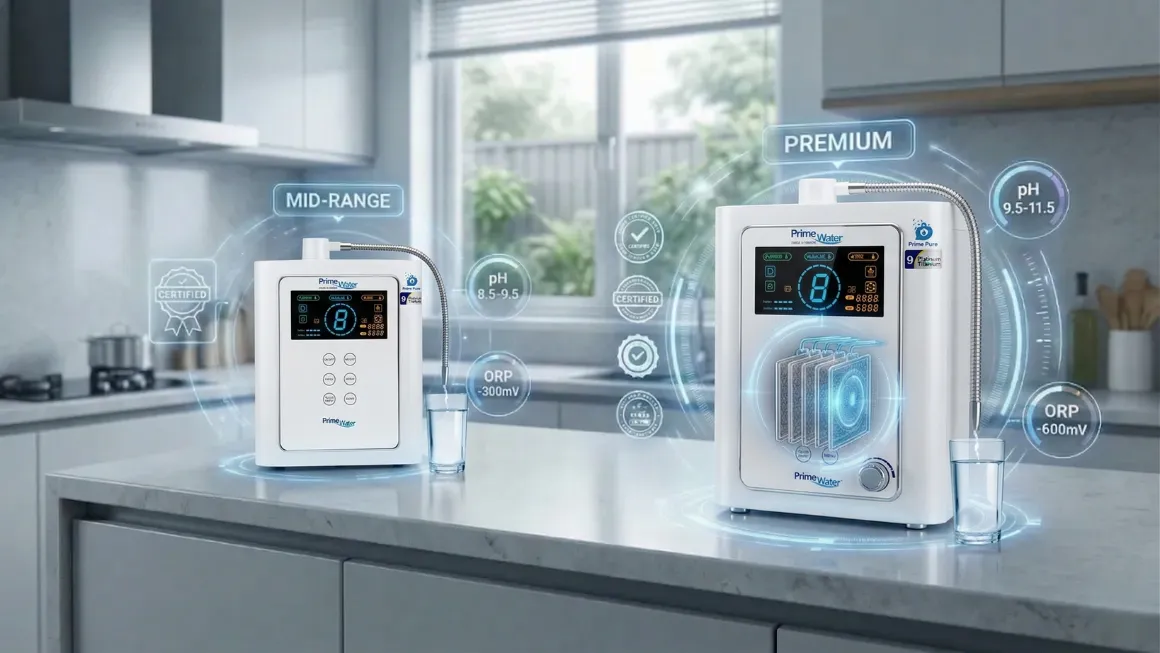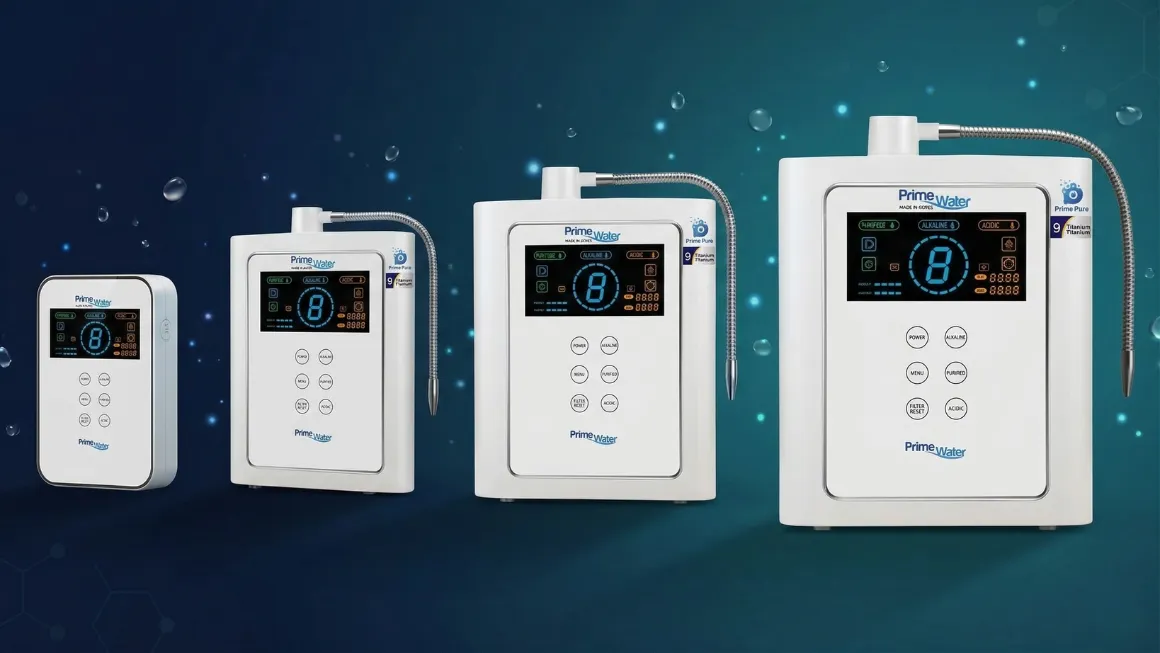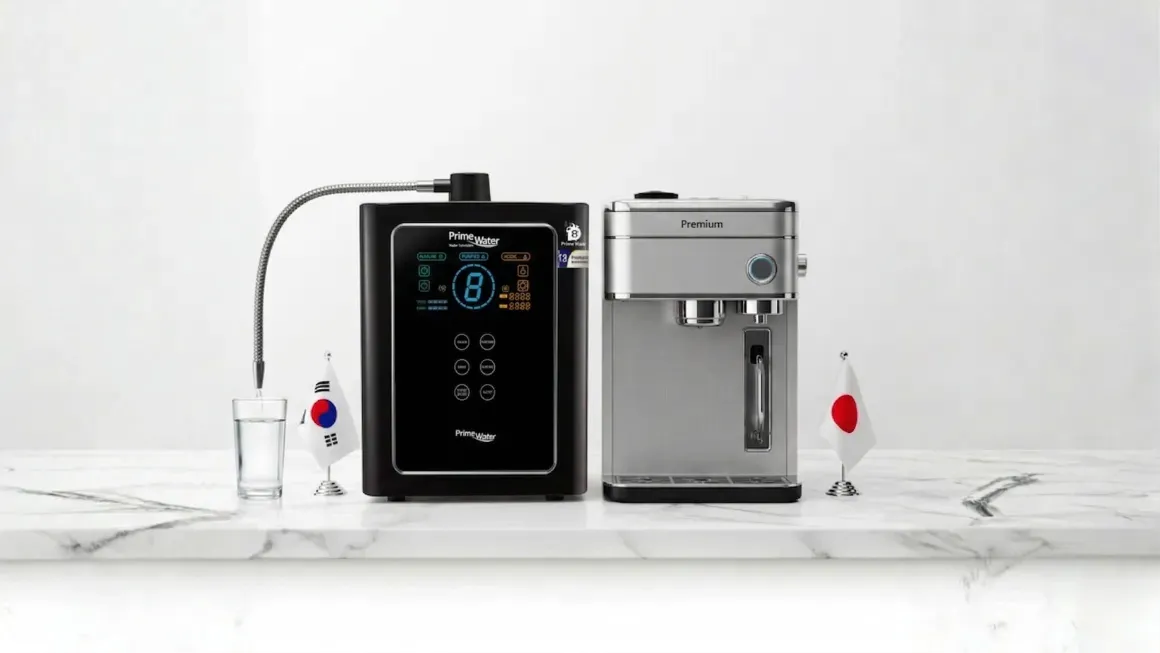
The two dominant countries in alkaline water ionizer manufacturing are Japan and South Korea. Between them, they produce virtually all of the genuine certified ionizers sold globally. In India, you'll encounter both — Japanese brands led by Enagic (Kangen) and Korean-origin machines like Prime Water.
So which country's technology is actually better? And which makes more sense for an Indian buyer? This guide answers both questions without brand loyalty.
Quick Navigation
A Brief History of Alkaline Water Ionizer Technology
Japan developed the first commercial water ionizers in the 1950s and 1960s. Ionised alkaline water was initially classified as a medical device in Japan and used in hospitals. South Korea rapidly developed its own ionizer industry from the 1980s onwards, studying and improving on Japanese methods, and now produces ionizers at similar or superior technical quality — with distinct advantages in cost, certification, and innovation pace.
Today, both countries have mature, well-regulated industries. The core technology — electrolysis using platinum-coated titanium plates — is identical between Japanese and Korean machines. What differs is the business model, plate count innovation, and how each country's machines are distributed and serviced in India.
The core technology is the same. Both Japanese and Korean ionizers use electrolysis with platinum-coated titanium plates to separate water into alkaline and acidic streams. The differences lie in plate count, power supply design, certification standards, pricing, and service infrastructure.
Technical Comparison — Korean vs Japanese Machines
When you compare the engineering specifications side by side, the gap between Korean and Japanese machines has narrowed considerably over the past decade. Korean manufacturers have closed the historical gap in quality while pushing ahead on plate count and output performance.
| Technical Factor | Japanese (e.g. Enagic/Kangen) | Korean (e.g. Prime Water) |
|---|---|---|
| Core technology | Electrolysis, platinum-titanium plates | Electrolysis, platinum-titanium plates |
| Power supply | Some models use linear PSU | SMPS (Switched-Mode Power Supply) — more efficient |
| Plate count range | 5–7 plates (most popular models) | 7–13 plates |
| Maximum ORP output | Up to –800 mv (SD501 top model) | Up to –1,250 mv (13-plate faucet) |
| pH range | 2.5 to 11.5 (standard) | 2.5 to 11.5 (standard) |
| Certifications | WQA, FDA, CE, ISO | KFDA, SGS, CE, FDA, BPA-Free, ANAB, KCL, EAC, PZH, FC |
| Innovation pace | Incremental (mature market) | Faster iteration (competitive Korean market) |
| Under-sink option | Limited models | Full faucet series (7 to 13 plates) |
| Self-cleaning | Yes | Yes (pre and post use) |
Table: Korean vs Japanese ionizer technology comparison. Korean machines lead on plate count and ORP output; both deliver equivalent core ionisation technology.
Certification Standards — KFDA vs JIS
Japan's water ionizers are governed by JIS (Japanese Industrial Standards) and approved by Japan's MHLW (Ministry of Health, Labour and Welfare). South Korea's are governed by KFDA (Korean Food and Drug Administration) standards — the same regulatory body that oversees pharmaceuticals and medical devices in Korea.
Both are rigorous. Both require independent testing of water-contact materials, performance validation, and electrical safety. Neither is definitively superior — they are different regulatory frameworks that have produced equally safe and effective devices from their respective countries.
Ionised alkaline water is officially classified as a medical device in Japan. JIS standards cover industrial quality, MHLW covers health and safety of water-contact components.
Standards: WQA · FDA · CE · ISO
KFDA is Korea's equivalent of the FDA — governing pharmaceuticals, medical devices, and health appliances. SGS certification adds a globally recognised independent testing layer.
Standards: KFDA · SGS · CE · FDA · BPA-Free · ANAB · KCL · EAC · PZH · FC
SGS advantage: SGS (Société Générale de Surveillance) is the world's leading independent testing and certification body, headquartered in Switzerland. The SGS certification held by Korean manufacturers like Prime Water adds an important third-party international verification layer beyond the national standard — one that Japanese machines don't typically carry. View Prime Water certifications →
Price Comparison — Why Korean Is 40–60% Cheaper
A 7-plate Japanese Kangen machine (SD501) typically costs ₹2.8–4.5 lakhs in India depending on distributor. A 7-plate Korean Prime Water machine costs ₹1,82,998 — roughly 40–60% less for equivalent plate count and comparable performance.
The reason is not inferior technology. It is business model. Enagic uses an MLM (multi-level marketing) distribution system with multiple levels of distributor commissions built into every sale. Korean manufacturers typically sell direct-to-consumer or through authorised dealerships without MLM markup. The machine itself is comparable — the distribution cost structure is not.
For ₹1.82 lakhs you get a KFDA-certified, SGS-tested, 7-plate Korean ionizer. For ₹3.5 lakhs you get a JIS/WQA-certified, 7-plate Japanese ionizer. Both produce quality alkaline ionised water. The difference in your bank account is significant — and with Korean machines you can step up to an 11 or 13-plate model for hard Indian water at a price still below most Japanese 7-plate options.
After-Sales Service in India
This is a critical practical consideration that often gets overlooked when comparing brands. For a ₹2+ lakh appliance you plan to use for 10+ years, who services it when something goes wrong matters significantly more than the brand on the box.
Service is typically handled by the distributor who sold you the machine. If your distributor leaves the network, moves, or closes — your after-sales support disappears with them. This is a real risk with MLM distribution and a frequently reported issue among Kangen owners in India whose distributors have relocated or exited the business.
Service is handled directly by the company, with service centres in Karnal and Gurugram and a network of trained technicians across India. You deal with the company, not an individual distributor. Your service relationship doesn't depend on one person staying in the business. Contact Prime Water service →
Which Is Right for You?
The honest answer depends on what you're actually optimising for. Here's how to choose:
- Brand prestige and the Kangen name specifically is important to you
- You have an established relationship with a trusted Kangen distributor who provides excellent local service
- You want to participate in the Enagic business opportunity
- You want equivalent performance at 40–60% lower cost
- You prefer dealing directly with the manufacturer
- You want the option of a higher plate count (up to 13 plates) for harder Indian water
- You value company-backed service rather than distributor-dependent service
Final Answer
Neither country's technology is inherently superior — both produce genuine, certified alkaline water ionizers that deliver health-grade ionised water. The platinum-coated titanium electrolysis process is the same, the pH and ORP output ranges are comparable, and both regulatory frameworks (KFDA and JIS) are rigorous.
The practical differences for Indian buyers come down to price, business model, plate count range, and service reliability — and on all four of these factors, Korean machines make a strong case for the majority of Indian buyers.
If you're buying an ionizer to drink better water every day — not to join a business — a KFDA-certified Korean machine gives you more plates, more certifications, lower cost, and more predictable after-sales service. That's a difficult combination to argue against.
Prime Water Models — Korean Engineering for Indian Water
Soft water households — Mumbai, Pune, Kolkata, most South Indian cities on municipal supply.
View RWB-7 Plate →Best value for most Indian urban households — Bangalore, Hyderabad, Delhi, Chennai.
View RWW-9 Plate →Hard water areas — Delhi NCR (harder zones), Haryana, Punjab, parts of UP and MP.
View RWS-11 Plate →Very hard/borewell water — Rajasthan, Haryana borewell, arid region groundwater.
View RBB-13 Plate →